

Two-Post Versus Four-Post Automotive Lifts: Which Is Best for Your Shop?
If you run an automotive service center, lifts are a necessity. Aside from making mechanics’ work easier, they help your service center maintain a professional image and build trust with customers. The challenge is that there are a lot of automotive lifts on the market to choose from. All lifts can be placed into one of four categories: two-post, four-post, inground, and mobile. In this article, we outlined the differences between in-ground and mobile lifts. However, in this article, we’ll cover the advantages, limitations, and best use cases for two-post and four-post lifts.
Two-Post Lifts
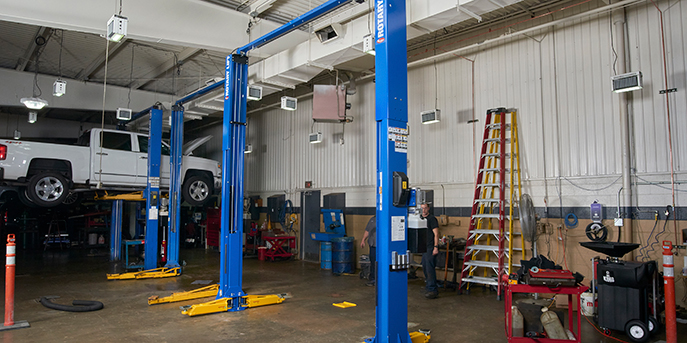
Two-post lifts feature (you guessed it) two vertical posts and arms that reach under the center of a vehicle’s frame to hold it in place and move it up and down as needed.
Due to their compact footprint, two-post lifts are ideal for home garages, smaller service centers, and general maintenance and light repairs.
Advantages
- Easy Servicing: Two-post lifts offer near-unobstructed access to a vehicle’s undercarriage, allowing easy access for maintenance and repairs.
- Ideal for Tire Services: In two-post lift designs, the wheels hang freely, making brake repairs and tire rotations easy and convenient.
- Great for Small Spaces: Their compact footprint makes them ideal for smaller service centers or home garages.
- Available in Multiple Styles: Two-post lifts are versatile and available in various styles and designs to suit your shop or garage’s layout.
- Cost: Two-post lifts generally cost less than four-post lifts.
Limitations
- Stability: Two-post lifts can be less stable than four-post lifts, primarily because they must be anchored to the foundation, which increases the risk of accidents. Precise vehicle positioning is necessary to ensure proper balancing of the vehicle.
- Service Limitations: Since two-post lifts secure vehicles at the pinch welds or frame, it can be difficult to perform four-wheel alignments, transmission services, exhaust work, and fuel tank removal.
- Lift Capacity: Two-post lifts aren’t ideal for some larger vehicles, notably SUVs and bigger trucks, due to the potential for height clearance issues that can make maintenance and repair work more challenging.
Best Environments
- Home garages
- Smaller automotive service centers
- Specialty repair centers that focus primarily on brake, tire rotations, and suspension work
Four-Post Lifts
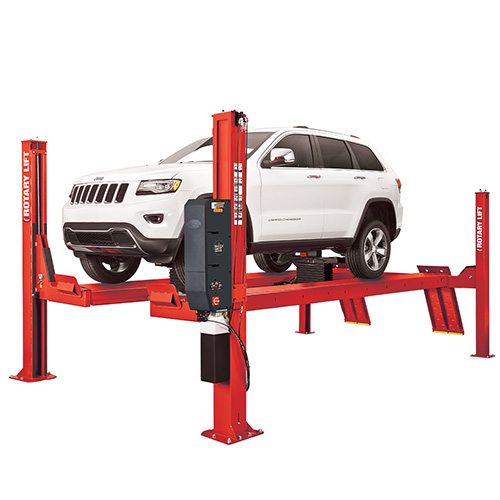
A four-post lift features four vertical posts for added stability. These lifts provide mostly unrestricted and safe under-vehicle access, and are capable of lifting heavy-duty trucks and other oversized vehicles. To operate a four-post lift, vehicles drive onto the “runways.” The vehicle is then locked into place and can be lifted. While two-post lifts are typically best for general maintenance and light repairs, four-post lifts are the better option for more intensive automotive services.
Advantages
- Safety: Four-post lifts offer more balanced support and better overall stability compared to two-post lifts.
- Versatility: Four-post lifts can support everything from small sedans to large trucks and SUVs.
- Application Flexibility: Four-post lifts are not only better for service centers that offer intensive automotive repairs, but they can also be used for vehicle storage.
Limitations
- Size: Four-post lifts have a larger footprint and take up more space in an automotive service center.
- Upfront Cost: Four-post lifts are the more expensive investment.
Best Environments
- Larger automotive service centers with plenty of floor space
- High-volume service centers or fleet maintenance centers
Determining Your Lift Needs
The type of lift you need largely depends on the nature of your business, the types of repairs you’re performing, and the types of vehicles you’re servicing. There is no superior option, and in some cases, you might find that both types are suitable for your space. Here’s what you should look at when evaluating lifts:
Offered Services
What kind of work are you performing in your shop?
A two-post lift will likely suffice if you’re performing mostly brake, suspension, basic oil changes, and tire rotations. However, if you’re performing more extensive automotive work or you’re running a high-volume oil change garage that services a variety of vehicles, a four-post lift is likely the better option.
Available Space
How much space do you actually have?
If space is limited, two-post lifts are a more compact option compared to four-post lifts. Four-post lifts take up more floor and ceiling space. However, also consider the future of your shop. If you plan to expand your space, investing in a four-post lift may be a better option.
Floor Thickness/Installation Requirements
What is the thickness of your existing floor?
For best results, both types of lifts require 4 to 6 inches of rebar-reinforced concrete as a foundation. Two-post lifts must also be anchored into the foundation for enhanced stability, while four-post lifts typically do not, thanks to their wider overall stance.
Need for Portability
How important is mobility?
Four-post lifts are more portable than two-post lifts simply because they don’t need to be anchored to the floor. Two-post lifts must be anchored to the foundation for enhanced stability, making it more difficult to move around the shop or garage.
Lift Capacity Needs
What types of vehicles are you servicing?
Most two-post lifts can support vehicles anywhere from 7,000 to 12,000 pounds, while four-post lifts can support vehicles weighing 30,000 pounds or more.
Find Your Lift at Allied, Inc.
Allied, Inc. is proud to be one of the largest automotive service equipment distributors in the United States. Since our founding in 1963, we’ve supplied the country’s automotive centers with heavy-duty lifts, wheel service equipment, air compressors, and more. We also offer other value-added services to automotive shops throughout Michigan and northern Ohio, including facility design, ALI-certified lift inspections, installations, and repairs, and air compressor service.
Visit our website to view our selection of two-post and four-post lifts. Don’t hesitate to contact us if you need help selecting the best one for your shop.