
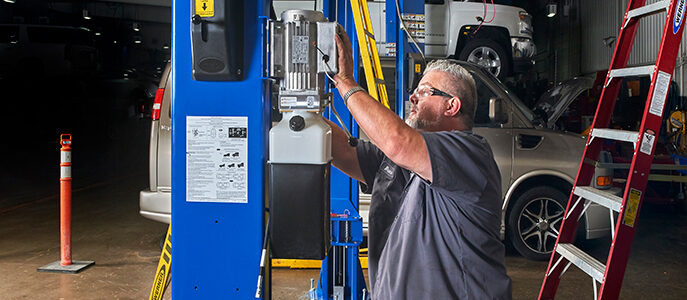
ALI-Certified Inspections: What Qualified Inspectors Look For
Anyone working under a vehicle wants to know it’s properly supported. Vehicles, even smaller and older models, weigh thousands of pounds, so any weakness or fault in a lift can lead to devastating accidents.
Managers must ensure their lifts are inspected daily, weekly, monthly, and quarterly. Managers should also ensure that every lift receives an annual ALI-certified inspection in accordance with ANSI/ALI ALOIM:2020 requirements. Qualified, ALI-certified inspectors will catch problems early, providing an opportunity to repair issues before they cause widespread deterioration, or to take lifts out of service if serious faults are discovered.
An ALI-certified inspection goes beyond what is normally included during standard operational maintenance checks. During these comprehensive inspections, ALI-certified inspectors evaluate:
General Operation
The inspector will operate the lift, with and without a vehicle in place, to verify that all features, especially those that are safety-related, work smoothly and as intended. Uneven lifting or motion, vibration, abnormal noises, or other indications of faults will prompt closer examination.
Rated Load Capacity
Exceeding the capacity of a lift is one of the leading causes of failure in an automotive lift. An ALI-certified inspector checks the capacity and that it is clearly displayed on the lift; overloaded lifts will be reported immediately.
Wear & Deformation on Components
Any deterioration is a cause for concern. Areas of particular interest include the cables and sheaves, slack cable devices that protect against cable failure, and ladder locks; cables can thin as they stretch or may have broken strands. Inspectors will also look for enlarged slots or holes and any cracked or bent components.
Missing Locks
Locks latch into the ladder as the lift raises a vehicle and support its weight while it’s being worked on. They are essential safety devices, and the inspector will verify they are present, undamaged, and working correctly.
Leaks
Leaks in a hydraulic system are a serious concern as they may lead to sudden failure when under load. An inspector will check the condition of all the hoses and cylinders. Any swelling, wear, drips, seepage, or any other signs of leaks are reasons for concern.
Foundational or Structural Issues
Concrete condition and post corrosion are the primary foundational/structural issues inspectors are looking for. Column anchor bolts will be checked for tightness, and the inspector will examine where lift posts are secured to the floor, looking for any indications of cracking or shifts that could make the lift move, distort, and eventually fail. Additionally, lift manufacturers, including Rotary, have strict requirements for concrete depth and integrity relative to lift capacity.
Electrical Issues
Wiring, switches, and control pendants are carefully examined for damage such as scuffs, cracks, and broken components to ensure they are in a usable condition, their markings are legible, and they will work safely.
Incompatible Accessories
In some cases, maintenance technicians will make changes or add devices to lifts to improve productivity or make life easier. These accessories must be removed before an inspection, as the ANSI/ALI ALOIM:2020 standard does not permit any additions or modifications to an automotive lift other than those engineered by the manufacturer.
Contact Point Damage
On two-post lifts and rolling jacks used on four-post lifts, contact pads take the full weight of the vehicle. The inspector will verify that there is no wear or rounding of edges and that the pads aren’t cracked.
Replacement Components
Lift components, particularly cables, will wear and must be replaced periodically. All replacement parts must meet OEM standards to ensure correct operation and long-term durability. If an inspector finds parts have come from non-approved sources, they will need to be replaced.
Only ALI-Certified Professionals Should Inspect Automotive Lifts
It’s good practice to check and perform routine maintenance on automotive lifts, such as removing road salt and other corrosive materials, inspecting cables for damage, and verifying that safety devices are functioning correctly. However, a formal inspection, as required by ANSI/ALI ALOIM:2020, performed by an ALI-certified inspector, should be scheduled annually.
If you haven’t scheduled your inspection yet, contact Allied Equipment. We’re ALI-certified and offer inspections throughout Michigan and northern Ohio. Get started today.