
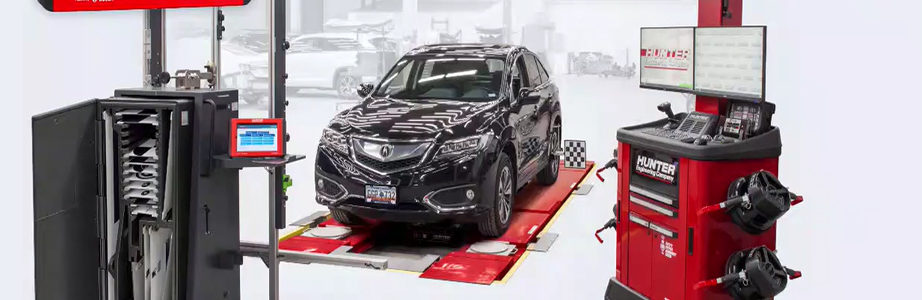
Buying a Wheel Alignment Machine: Factors to Consider & Product Recommendations
You likely don’t need any convincing regarding the benefits of wheel alignment. It’s a vital service that reduces tire wear and improves vehicle steering. Plus, America’s continually potholed roads mean wheel alignment will be needed for years to come.
The key to profiting from wheel alignment services is using the right equipment. This blog highlights key factors to consider when choosing the best wheel alignment machine for your shop.
What Types of Vehicles Do You Service?
Modern alignment systems use cameras to view targets or patterns fixed to each wheel. However, this only works if the system can see them, so it must be sized for the vehicles you’ll be working on.
Wheel size is a significant factor to consider, along with vehicle length and height. Light-duty cars, trucks, vans, and SUVs are usually small enough to be covered by a relatively compact system. Bigger vehicles, like buses, motor coaches, and Class 8 trucks, need an alignment system that goes wider and higher.
Vehicle weight is another consideration. The alignment lift must be capable of safely raising what you’re putting on it. So again, a Class 8 truck needs much more load capacity than a minivan or a compact SUV.
Can you align a small vehicle on a large system? Usually, yes. But a larger system needs more space, which is another factor to consider.
Consider Space & Future Needs
A modern alignment system has two main elements: a lift to raise the vehicle and a sensor head that carries the cameras. For installation, you need a bay large enough for the lift and enough space in front of the lift for the sensor head. Details vary by vehicle and system type, but this may mean another 4 to 6 feet of space in front.
Remember to anticipate future growth in your operation and changes in how your space is used. A particular area might work well now for wheel alignment, but if it restricts vehicle movements in the future or limits what you can work on, that could become a problem. When deciding how much space is available for wheel alignment, consider whether the preferred spot might limit what you want to do in the future, and plan accordingly.
You should also consider whether you might want to add ADAS calibration capabilities in the future. ADAS is fast becoming standard on new vehicles, and calibration is something more customers will be looking for. Even if you don’t want to offer it now, consider choosing a system that can be upgraded to provide it, or one that already includes it, even if you don’t use the feature immediately.
How Often Do You Perform Alignments?
If you will be carrying out multiple alignments every day, ease of access, setup speed, and actual alignment time are important factors. A faster system will mean higher productivity and more work for your shop.
However, the faster, more sophisticated systems also carry a higher price tag. That means that if alignment work only comes in a few times a week, a slower but less costly system might be the better choice.
One useful feature for higher productivity is synchronization between the wheel alignment machine and the turn plates. Another is turnplates and slip plates that automatically lock and unlock as needed. Fast install/quick release installation arms for mounting 3D targets also help keep technicians productive.
Reliability & Tech Support
Shop equipment doesn’t always get treated with kid gloves. It’s used in an (often) dirty environment, and accidents can happen. This is why reliability and backup are important points to consider. Ideally, your equipment will survive any mishaps unscathed, but if help is needed, you want to know it’s available. That’s why you should check what the equipment vendor and/or manufacturer has to say about these points.
Do You Need a Computerized Solution?
Yes, you need a computerized solution for profitability.
There’s no doubt that an experienced technician can do a good alignment using the traditional methods. However, a modern computerized system can do it faster and more accurately. Cameras, sensors, targets, and software together yield more accurate measurements in less time. Plus, they’re repeatable, which increases customer confidence and avoids the challenge of tracking down the “best” alignment tech.
Today, computerized wheel alignment is just standard industry practice. Some computerized wheel alignments can be done in just as little as 10 minutes, excluding time needed for a technician to perform initial inspections, drive a vehicle onto a lift, mount and calibrate sensors, etc.
Comparing Our Recommendations
As a leading distributor of automotive service equipment, we’re very familiar with the products we offer. If you’re buying a wheel alignment machine, we’d steer you towards Hunter products, which we’ve always found to be accurate and reliable. The primary choices are the HawkEye Elite®, HawkEye® XL, and ProAlign (Standard Alignment). Here’s a comparison of these alignment systems (excluding the lift):
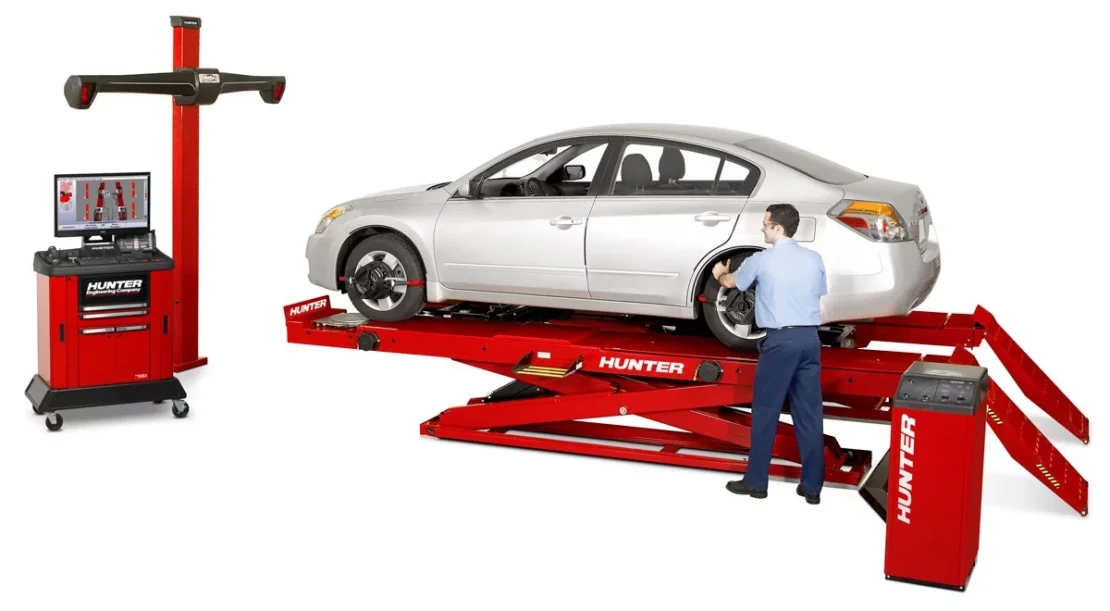
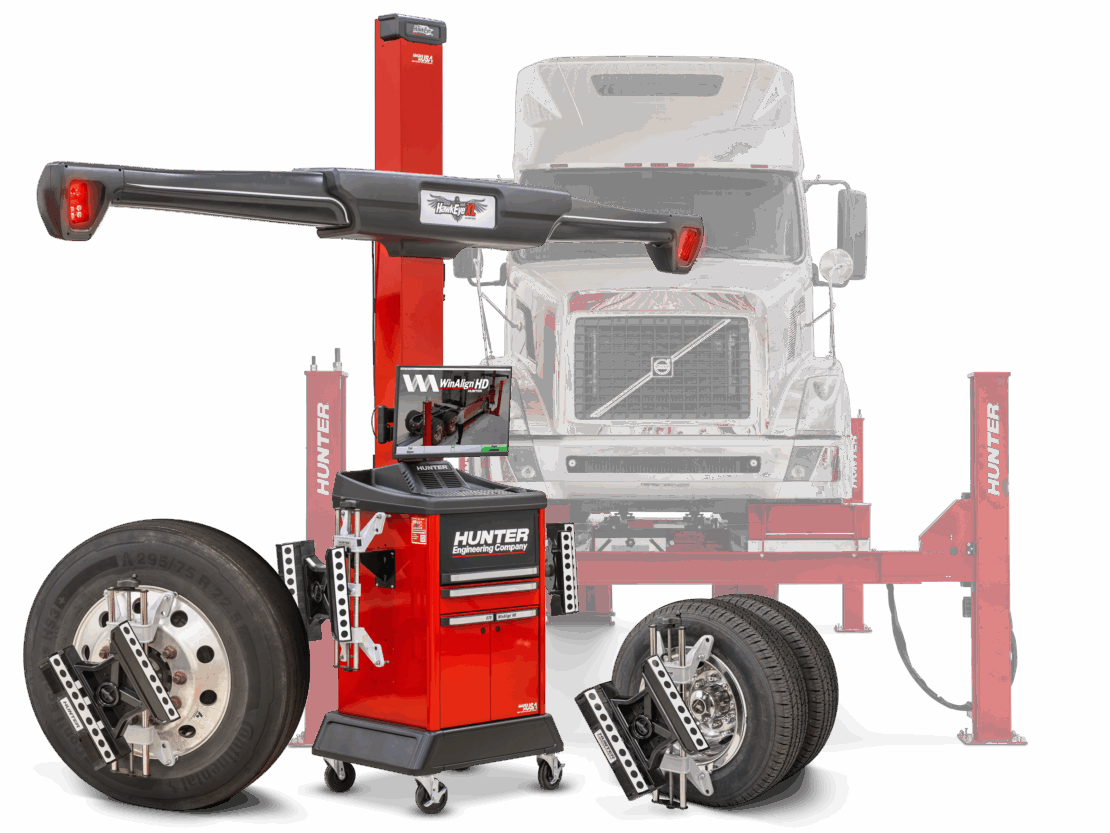
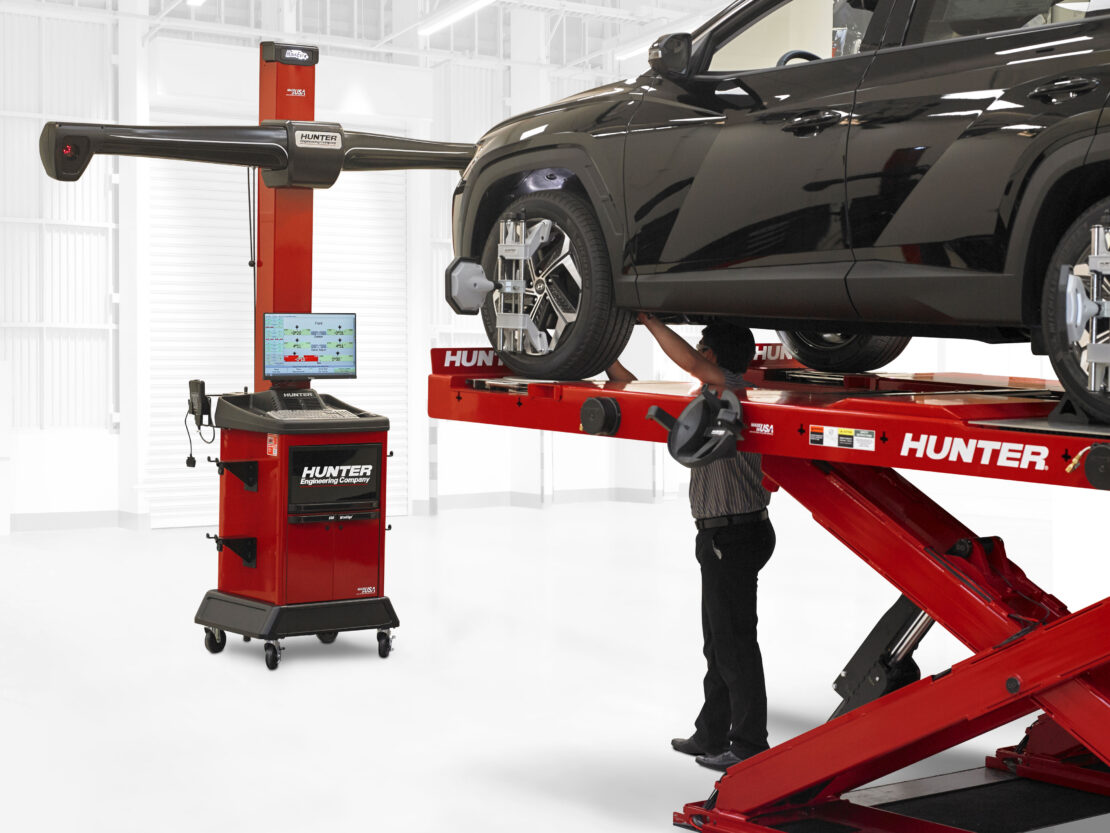
| Product Name | HawkEye Elite® | HawkEye® XL | ProAlign (Standard Alignment) |
| Size/Footprint | 105” x 122.5”x 15” (H/W/D) *Depth varies based on the model, and can range from 15” to 30.” | 134” x 118”x 26” (H/W/D) *Base Width is 33” | 105” x 105.5”x 25” (H/W/D) *Depth and height vary based on model. Maximum height is 122.5” and minimum depth is 15”. |
| Best For | Light vehicles | Heavy- and medium-duty commercial vehicles | Light vehicles |
| Reading Times | 70 seconds | 4 minutes (Standard 3-axle tractor) | 70 seconds |
| Standard Features | • Four high-resolution cameras • WinAlign® software • Fully integrated alignment rack integration • Sensors available in several mounting configurations, including wall/ceiling, fixed single column floor, manually adjustable single column floor, electronically adjustable column floor, manually adjustable mobile cabin. | • Durable 3D XL targets • WinAlign® software • High-definition • cameras • Multi-axle reading • Allows alignments in multiple bays. • Adjustable height • Quick rolling compensation in one motion. | • High-resolution cameras • Reflective wheel targets • WinAlign® Lite software • Self-centering wheel adaptor • Intuitive 24” LCD flat panel display |
Find the Right Wheel Alignment Machine
Allied, Inc. provides reliable automotive service equipment, including lifts and wheel alignment machines, to auto dealerships, service garages, and fleet operators across the United States.
Visit our website to learn more about our product recommendations, or contact us today to place an order.