
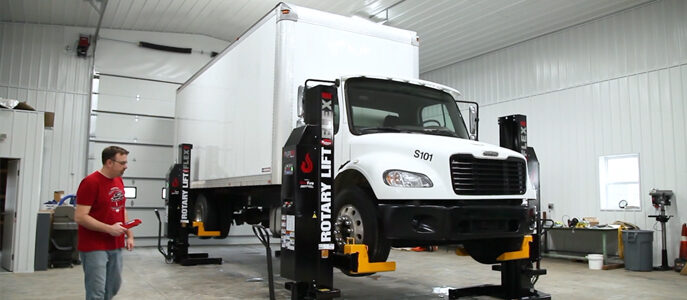
Buyers’ Guide to Mobile Column Lifts
Automotive lifts are arguably one of the most important pieces of equipment for any automotive shop, which is why you should really take the time to think about what type of lifts you need and which specific models to purchase.
If you’ve decided to invest in a mobile column lift, it’s likely because you’re prioritizing flexibility and ease of use. While all mobile column lifts offer these two primary benefits, you still need to compare potential lifts based on your shop’s unique requirements, including service offerings and available space.
What to Consider When Purchasing Mobile Column Lifts
Vehicle Weight Capacity
The size of the vehicles you’re servicing will inform how many columns you need. You can get away with two columns for cars and light trucks, but heavier vehicles or heavy-duty trucks will require at least four.
Use the vehicle manufacturer’s specifications to find the weight capacity (not just the curb weight), and also identify the weight on each specific axle of the vehicle.
From here, you can calculate the required lift capacity by dividing the weight of the axle you need to lift by two and then adding a safety buffer. After calculating the vehicle weight capacity, you can determine what mobile lift and how many columns are adequate for the vehicles you commonly service.
Clearance & Space
Mobile column lifts require a sufficient ceiling height for safe and effective operation. Generally, you’ll want to allow a minimum of 12 feet in your shop; however, this depends on the specific vehicle being serviced and the type of lift being used. Additionally, you need to account for overhead hazards, such as lights and other obstructions, to ensure a comfortable amount of working space.
Use this formula when determining your available clearance and space:
Vehicle height + lifted height + overhead clearance margin
Measure the height of the tallest vehicle you plan to service, then check the mobile column lift’s lifting height and height of its carriage arms. When calculating overhead clearance, budget for at least 6 inches more to ensure adequate working space and prevent contact with overhead obstructions. If the formula is less than your ceiling height, you should be good to proceed with that specific lift. If not, you may have to move the lift to another area of your shop, consider a different lift, or make modifications to your shop to adequately support it.
Portability Requirements
The two main types of mobile column lifts are wireless and cabled. Wireless mobile column lifts use internal batteries to power the lift mechanism, whereas cabled systems are hard-wired but may also utilize batteries. Both have their share of advantages and limitations.
Wireless lifts offer superior mobility and flexibility and are easier and faster to set up because they don’t have cables. They can also be used anywhere. However, they have a higher upfront cost and require regular recharging and battery maintenance. Battery life will vary based on the model, but it typically ranges from 10 to 30 lifts per charge.
Compared to wireless systems, cabled systems are more affordable, making them an excellent option for shops that don’t want to commit to a fully wireless system. However, the cables can pose a safety hazard and make installation more challenging, which isn’t an issue if you don’t plan to install the lift yourself. They can also limit mobility and placement options, but keep in mind that some cabled systems come with optional batteries for added flexibility.
Bottom line: Opt for a wireless mobile column lift if flexibility and speed are your shop’s top priorities and if you’re disciplined enough to recharge and maintain the batteries. Cabled lifts are better for more budget-conscious shops that don’t need to frequently reposition lifts.
Column Control
Mobile columns can be operated wirelessly via a remote or manually with a wired pendant or central control unit. In some models, the columns themselves are movable and can be positioned around the vehicles. Manual raising doesn’t require battery maintenance or recharging, but it’s also less efficient because it takes time to manually adjust each column and check for potential safety issues.
Wireless control allows you to adjust columns faster and simultaneously to prevent tipping. However, they’re more expensive systems that require routine charging. They can also experience connectivity issues that can impair operator safety, especially when they occur while the columns are being adjusted.
Most mobile column lifts feature a wireless remote control system with advanced safety features to improve productivity and efficiency, but manual options are available if connectivity is an issue at your location.
Our Mobile Column Lift Recommendations
FLEXMAX™ MCHM14
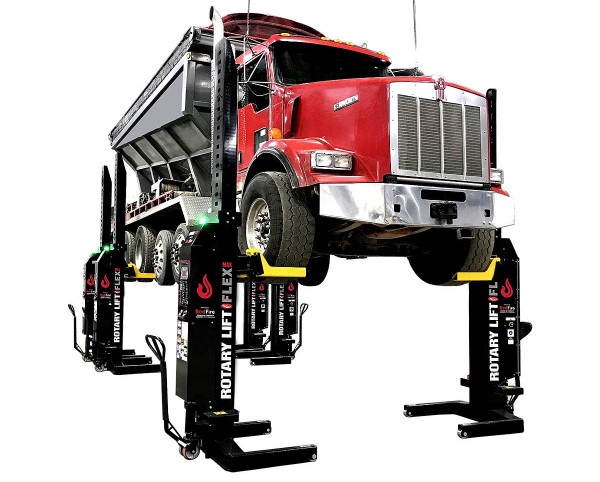
The FLEXMAX MCHM14 is a wireless mobile column lift system that can hold vehicles weighing up to 112,000 pounds, depending on the number of columns in your configuration. Its single-column capacity is 14,000 pounds. All models in the FLEXMAX™ series feature a single lower-to-low button with an E-stop to reduce accidents, single column controls, visual indicators to show when columns have been locked, and adjustable lifting forks that allow operators to adjust odd and even column groups with a forklift.
Specs:
- Columns: Up to 8
- Single Column Lift Capacity: 14,000 lbs.
- Type of System: Wireless
- Column Rise: 69 In.
- Rise Speed: 68 Seconds
- Voltage: 110V
- Wheel Rim Size: Up to 24 In.
FLEXMAX™ MCHM19
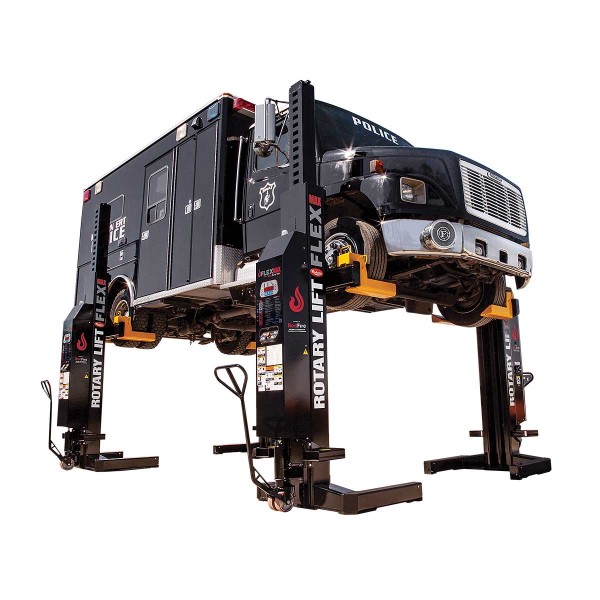
The FLEXMAX MCHM19 offers more lifting capacity than the MCHM14 wireless system—a single column has a capacity of 18,000 lbs. Like all lifts in the FLEXMAX, it features a lock-and-lower button with an E-stop, an intuitive interface that indicates when columns are locked or unlocked, and portable columns that can be easily moved around with a forklift.
Specs:
- Columns: Up to 8
- Single Column Lift Capacity: 18,000 lbs
- Type of System: Wireless
- Column Rise: 70 In.
- Rise Speed: 78 Seconds
- Voltage: 110V
- Wheel Rim Size: Up to 24 In.
MACH Wireless MCHW18
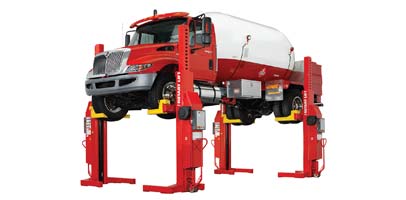
The MCHM18 is a lighter-duty option than the FLEXMAX MCHM14 and MCHM19. It can be configured with four columns, each with a load capacity of 18,000 lbs. It features internal horseshoe wiring with wireless controls for easy drive-on/drive-off operation, plus retractable cord reels and quick-connect cables. This wireless lift also features internal chargers to improve portability.
Specs:
- Columns: Up to 4
- Single Column Lift Capacity: 18,000 lbs
- Type of System: Wireless
- Column Rise: 70 In.
- Rise Speed: 78 Seconds
- Voltage: 208V, 230V, or 460V
- Wheel Rim Size: Up to 24 In.
Get Help From Allied, Inc.
Allied, Inc. is a U.S.-based lift supplier serving shops throughout the United States. If you need help finding the right solution for your shop, contact our product specialists today. We offer all types of lifts, including two-post, four-post, in-ground, and mobile column. We can even provide installation, inspection, and repair services for shops in Michigan and northern Ohio.